
Twenty-odd part numbers, reduced to three.
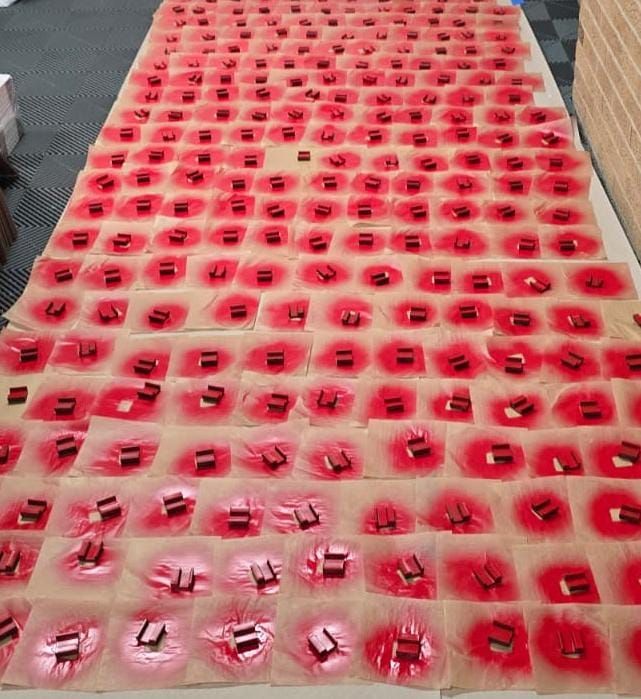
The TKTS Red Steps are an all-glass staircase in the middle of Times Square that thousands of people sit on every day. Every red glass riser rests on custom support blocks — and because a structure like that is full of construction tolerance, the original solution needed a different bespoke block for nearly every position. We worked with the customer to collapse that family into three stackable blocks, then produced 900 parts in SLS nylon — 300 of them finished in cherry red.
20+ → 3
Unique part numbers, consolidated
6
Stack sequences cover every height
900
Parts produced
300
Hand finished in cherry red
The brief
A landmark that has to fit together, in the real world
The enquiry came in from one of New York City’s larger glazing contractors — the kind of firm that builds and then maintains the projects everyone photographs. One of those is the TKTS structure in Times Square.
Here is the problem with an all-glass staircase: glass is made to a tolerance, structural steel is built to a much looser one, and the gap between them has to be taken up by something. On the Red Steps that something is a small support block sitting under each glass riser. Every position needs its own height. Get it wrong and the pane either rocks or takes load where it should not.
The original approach handled that the obvious way — a separate bespoke block for each height, more than twenty distinct part numbers across the structure. It works, but it means twenty-plus things to make, twenty-plus things to stock, and twenty-plus opportunities for the wrong one to end up in someone’s hand eight meters up a staircase in Times Square.
The customer arrived with a better idea already sketched: stop making bespoke heights, and start stacking. Our job was to turn that idea into parts that could actually be manufactured, prove it, and then produce them.

Project
TKTS Red Steps, Times Square
Client
Major NYC glazing contractor
Service
Design for manufacture + production
Process
SLS, nylon
Run size
900 parts · 300 color finished
Finish
Cherry red, to customer spec
The solution
Three blocks that stack in any order
One base block that takes the glass, plus two shim plates of different thicknesses. Stack them in different combinations and a handful of parts covers the whole range of heights the structure needs — no bespoke block, no special order, nothing to mix up on site.
Stack sequences used on the structure
Diagram is schematic — proportions illustrate the principle, not the dimensioned design.
Fewer things to get wrong
One base and two shims replace a drawer full of bespoke heights. Site crews combine rather than select.
Volume on three tools, not twenty
Consolidating the family means every part is made in quantity, which is what makes a run like this economic.
Finish only what shows
Only the visible blocks needed color, so the finishing work — and its cost — was applied where it actually matters.
How it went
Concept to 900 finished parts
Design for manufacture, iterations, physical samples, sign-off, then a production run — in that order, because on a job with 900 parts you only get the tolerance question wrong once.
The conversation before the CAD
The customer came to us with the stacking concept and a fabrication drawing showing how the blocks were intended to combine. What they needed was someone to tell them whether it would actually work as a made part — and then make it.
That is the part of a job like this that is easy to skip and expensive to skip. A stacking system lives or dies on the interfaces: if each block has a generous fillet where the designer drew one, the stack no longer closes, and a 0.5 mm gap repeated three blocks deep becomes a rocking pane at the top.
Design for manufacture — the fillets are the whole job
The geometry we took to production is named, in our own file system, for the two changes that mattered: zero added clearance and reduced fillets.
Those two decisions are the engineering content of this project. Powder-bed nylon parts come out very slightly proud of nominal, so adding a clearance allowance on a mating face that is supposed to sit flush works against you. And a fillet left in an internal corner stops the block above from seating. Taking them down — without leaving a sharp internal corner that becomes a crack initiator under load — is the balance the part has to strike.
Iterations and physical samples
We sent the customer several iterations and then, crucially, actual parts in the actual material. A stacking tolerance is not something anyone can approve from a screenshot — you have to put three blocks on a bench and try to rock them.
Samples went out, the customer stacked them, and the design was approved off the physical parts rather than the model. The production order followed.
Production — 900 parts, powder bed
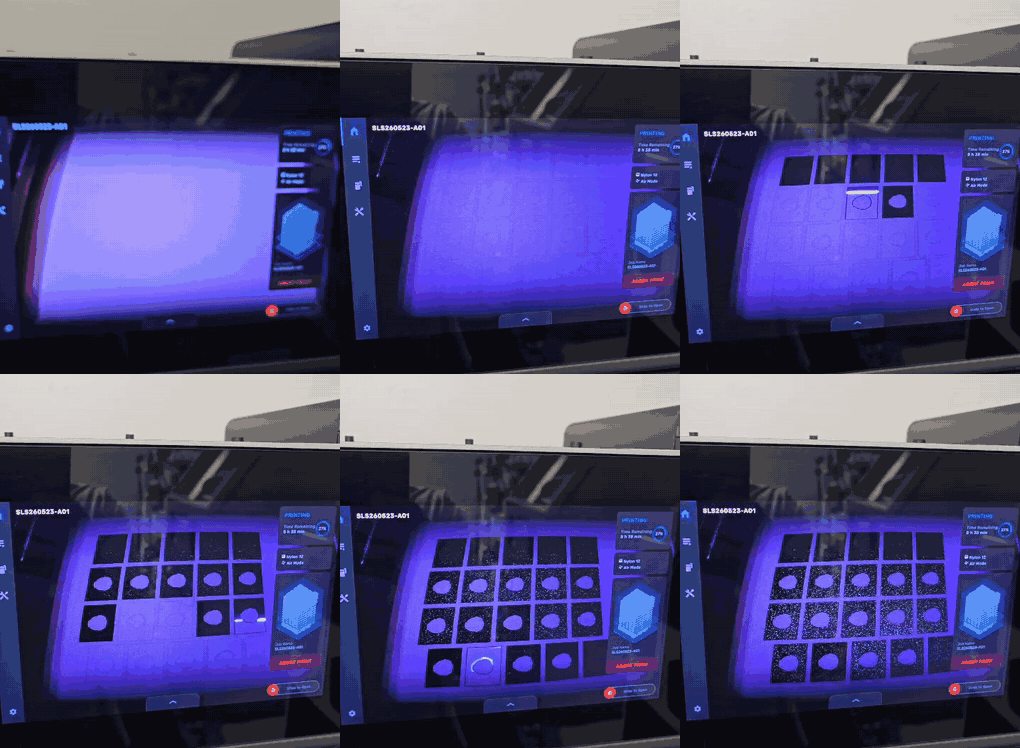
Parts were produced on our own SLS machine in nylon. Powder-bed is the right process here for reasons that are specific rather than generic: there is no support structure to remove, so the mating faces come out untouched; parts nest three-dimensionally in the build volume, so a run of hundreds of small blocks is efficient rather than painful; and nylon has the toughness and the dimensional stability to sit outdoors under a glass staircase in a New York winter.
Finishing — 300 in cherry red
The Red Steps are red. Where a block sits somewhere it can be seen through the glass, gray nylon would read as a defect, so the customer specified a cherry red finish on the visible blocks.
Three hundred parts were laid out and spray finished by hand. That is genuinely slow work — every part masked by position, sprayed, and left to cure without touching its neighbour — and it is the reason the consolidation mattered so much. Finishing 300 identical blocks is a production task. Finishing 300 blocks across twenty part numbers is a logistics problem.
Delivered
All 900 parts shipped complete. The customer confirmed receipt, was happy with the result, and has already talked to us about the next one.
Which is the honest measure of a job like this. Nobody visiting Times Square will ever see these blocks, or know they exist. They will just sit on a glass step that does not move.
Got a part family that could be a smaller part family?
Send us the drawing. We will tell you honestly whether consolidating it is worth the design time — and if it is, we will design it and produce it.