
Nylon 3D Printing Service
PA12 nylon: material properties, finishing, and real use cases
A working engineer's reference on PA12 — how it behaves, what it feels like in your hand, what colors are possible, how to join it, and when to step up to PA12-GF.
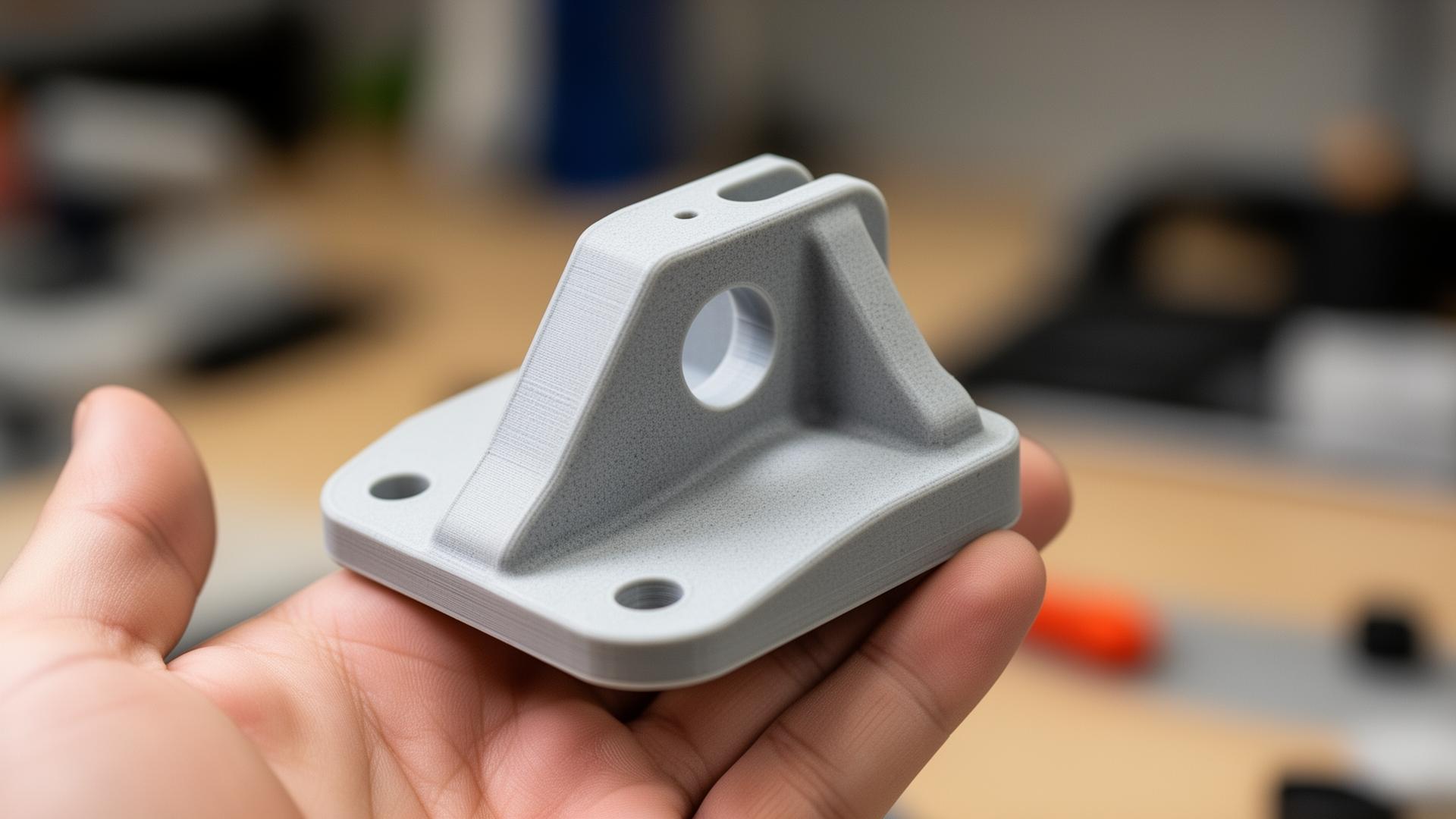
Most articles about "nylon 3D printing" stop at "PA12 is strong and survives drops." That's true but useless if you're actually trying to design a part. What follows is a working engineer's reference on PA12 specifically — how the material behaves, what it looks and feels like in your hand, what colors are possible, how to join PA12 parts to other PA12 parts (or to other materials), how long it lasts in service, and when to upgrade to PA12-GF.
What PA12 actually is
PA12 — polyamide 12 — is a thermoplastic nylon in the same chemical family as PA6 (used in carpet, fishing line, and most cheap nylon hardware) and PA11 (used in fuel lines and high-end sports equipment). The "12" refers to the number of carbon atoms in the molecular repeat unit.
That number matters because the carbon backbone length controls two key properties:
- Moisture absorption. PA6 absorbs ~10% of its weight in water (which changes its dimensions). PA12 absorbs ~1.5% — practically dimensionally stable.
- Crystallinity. PA12 crystallizes more slowly than PA6, which lets the SLS process produce parts with consistent properties throughout the build.
This is why PA12 is the dominant SLS material even though it's more expensive per kilogram than PA6. The SLS process specifically needs a material that can be repeatedly melted and re-fused without major property changes between cycles, and PA12's behavior makes that work.
What PA12 parts look and feel like
Out of the printer, PA12 has a distinct character that's worth understanding before you commit to it:
- Color: natural matte gray, sometimes described as "light beige" depending on the specific powder lot
- Surface texture: subtle grainy feel — like very fine sandpaper, but smooth enough to handle comfortably
- Weight: density ~0.95 g/cm³, slightly less dense than water (PA12 parts float)
- Sound: struck against a hard surface, PA12 has a soft "thunk" — not the bright ring of injection-molded plastic
- Temperature on touch: feels neutral, neither warm nor cold (unlike metal)
Customers often comment that PA12 parts feel "more substantial than they look." That's the slightly higher density combined with the matte finish — visually understated, physically solid.
The mechanical numbers that actually matter
For engineering decisions, the headline mechanical properties for SLS PA12 (typical values; vary by build orientation and processing):
| Property | Value | What it means |
|---|---|---|
| Tensile strength | 45–50 MPa | Will hold ~700 psi pull before breaking |
| Tensile modulus | 1,700–1,800 MPa | Moderately stiff, deflects under load |
| Elongation at break | 18–24% | Bends/deforms significantly before snapping |
| Flexural modulus | 1,500–1,650 MPa | Resists bending similarly to ABS |
| Notched Izod impact | ~32 J/m | Survives drops better than PLA, worse than ABS |
| Heat deflection (0.45 MPa) | 160–170 °C | Stable in hot car interiors, near boiling water |
| Heat deflection (1.82 MPa) | 80–95 °C | Loses load-bearing capacity in sustained heat |
| Continuous service temp | ~170 °C | Works long-term up to that range |
A useful comparison: injection-molded PA6 is meaningfully stronger (~80 MPa tensile, ~3,000 MPa modulus). SLS PA12 sits between injection nylon and ABS — closer to molded nylon than most additive materials, but not equivalent. For applications where the part replaces molded nylon eventually, plan for the slight strength downgrade.
Color and dye chemistry
The natural gray of PA12 is the default. Options for color:
Black dye (standard)
A standard immersion dye bath using a heated solution of nigrosine or similar industrial dye. Parts are submerged for 30–90 minutes, which colors the porous surface evenly to a depth of ~0.3 mm. Black is the catalog default because nigrosine is colorfast and the porosity of PA12 takes it deeply and uniformly.
Why only black?
Other colors are physically possible but less reliable: pigments for red, blue, green penetrate unevenly and show streaking; dye baths need to be dedicated per color, which makes small custom-color runs uneconomical; and non-black colors fade noticeably in UV.
Paint (for full color matching)
Primer + paint to spec, including Pantone matching for production runs. Allows precise color control and full surface coverage. Adds 0.1–0.3 mm to part dimensions (account for this in tolerance-critical features). Quoted as a custom finishing step — email quotes@quote.partguys.io.
Polishing
Vibratory tumbling with abrasive media smooths the grainy surface to a more uniform, slightly satin finish. Useful for cosmetic parts or assemblies where the grain would catch on other surfaces. Doesn't significantly change color, but the smoother surface reads as slightly darker.
Joining PA12 to PA12 (and to other materials)

Most PA12 parts need to attach to something — other PA12 parts, metal hardware, electronics, or assemblies. What works:
Mechanical fasteners with heat-set inserts
The standard approach. Heat-set inserts (brass threaded inserts pressed into oversized holes with a soldering iron) give you metal threads in a PA12 part. M3, M4, and M5 are commonly stocked. Pull-out strength is ~150–250 N depending on insert size. The right answer for any fastener you'll cycle more than a few times.
Tapped threads (for non-cycled fasteners)
Print the hole undersize, tap with a standard tap. Works fine for assemblies you'll thread once and leave. Don't use for repeated assembly — the threads strip within 10–20 cycles.
Adhesives
PA12 has low surface energy, so adhesion is harder than with PLA or ABS. Cyanoacrylate (super glue): modest hold, good for jigs. 2-part epoxy: strong hold, ~10–15 MPa shear — the standard choice for permanent bonds. Polyurethane: flexible bonds for parts that need to vibrate. Light sanding or plasma treatment significantly improves bond strength.
Welding
PA12 can be ultrasonically welded to itself with the right setup, but the SLS surface texture makes welding less reliable than on injection-molded PA12. Solvent welding doesn't work well — PA12 is too solvent-resistant.
Mechanical interlocks (printed assemblies)
Often the best joint design for SLS PA12 is one you don't add — print the assembly as a single piece with internal interlocks. SLS's support-free printing makes this trivial.
Surface treatments for service environments
PA12 is durable but not magic. For demanding environments:
- Friction surfaces. PA12 has a natural slip property similar to nylon-on-nylon, with a coefficient of friction around 0.3–0.4. For gears and bearings, this is usually fine without lubrication. For lower-friction applications, PTFE-impregnated PA12 is available as a specialty partner-network grade.
- UV exposure. PA12 yellows and gets brittle over years of direct sun. For outdoor service, paint provides UV protection. For unpainted parts, expect 2–5 years of service life before visible degradation; structural integrity holds longer.
- Solvent/chemical resistance. Highly resistant to most fuels, oils, and alkalis. Attacked by strong mineral acids, concentrated formic acid, and some chlorinated solvents.
- Moisture cycling. PA12 absorbs and releases moisture (~1.5% by weight at saturation) without permanent dimensional change. For ultra-precise dimensional stability, condition the parts before measurement.
PA12 vs PA12-GF: when the glass-filled upgrade is worth it
PA12-GF is glass-fiber-reinforced PA12. Roughly:
- ~2× stiffer (modulus ~3,200 MPa vs ~1,750 MPa)
- ~50% higher heat deflection temperature
- Slightly more brittle (lower elongation at break)
- More expensive per part
- Available at PartGuys via partner-network printing only
When to use PA12-GF
- Brackets and housings under load that flex too much in standard PA12
- Parts in sustained heat above 100 °C
- Thin-walled metal-replacement brackets at lower weight
When standard PA12 is fine
- Parts that need to flex without breaking — living hinges, snap-fits
- Tight-tolerance mating surfaces (GF has slightly higher dimensional variation)
- Cosmetic parts — GF has a noticeably rougher surface
For most engineering parts, plain PA12 covers the use case. Reach for GF only when standard PA12 specifically fails the requirement.
PA12-GF routes through partner-network printing with a separate quote and a longer lead time, clearly flagged on the order. Plan for that path up front if your part needs the added stiffness or heat resistance.
Real-world applications where PA12 shines
The use cases where SLS PA12 wins over alternatives:
- Drone airframes and arms. Light, strong, survives drops, easy to repair (reprint the broken part).
- Robotics chassis. Captured assemblies print pre-articulated, reducing assembly time.
- Custom automotive interior parts. Heat-tolerant enough for cabin temperatures, easy to dye black to match OEM trim.
- Prosthetics and orthotics. Skin-safe (after appropriate finishing), patient-specific geometry trivial to produce.
- Industrial fixtures and jigs. Replaces machined aluminum at a fraction of cost and lead time.
- Replacement parts for legacy equipment. Scan or model the broken part with our design service, then print a PA12 substitute.
- Pre-production samples for injection-molded products. PA12 behaves close enough to molded PA6 to validate the design.
What PA12 doesn't replace well:
- High-volume injection-molded consumer goods (cost-per-part economics)
- Optically transparent parts
- Sub-0.1 mm tolerance metal parts (use CNC — a separate process, not additive)
- Parts needing FDA medical-device certification (requires specific qualified vendors)
For deeper guidance on part geometry, our design guidelines article covers wall thickness, tolerances, and printability rules in depth.
Ordering PA12 parts
1. Upload your file
Drop an STL, STEP, OBJ, PLY, or 3MF file at partguys.io. No account required. Files are transmitted over TLS and stored encrypted at rest; NDA Protection Active is available on every quote.
2. Select technology and material
Choose SLS as the technology and Nylon 12 (PA12) as the material. For glass-filled, select Glass Filled Nylon — that routes through the partner network with a separate lead time visible on the quote screen.
3. Pick finishing
Standard natural gray (default), black dye, or polish. For paint or custom finishing, email quotes@quote.partguys.io with your spec.
4. Pick quantity and queue
Economy (5 business days), Priority (1.25×, 3 business days), or Rush (2.2×, 1 business day, orders of $50 or more).
5. Check out
Guest checkout or sign in for file persistence, order history, and one-click reorders.
For the full end-to-end flow from upload to delivery, see how it works. If you're moving a PA12 prototype into recurring batches, our production 3D printing service guide covers qualification and reorder mechanics.
Frequently asked questions
What is PA12 nylon and how is it different from regular nylon?
PA12 (polyamide 12) is a thermoplastic in the same chemical family as PA6, with a longer carbon backbone. The extra carbons mean much lower moisture absorption (~1.5% vs ~10% for PA6) and slower crystallization, which makes it dimensionally stable and ideal for the SLS process.
What colors can I get for SLS PA12 parts?
Natural matte gray is the default. Black dye is the standard catalog color — parts are immersion-dyed for an even, colorfast finish penetrating ~0.3 mm into the surface. Other colors are physically possible but less reliable; for full color matching, paint is the better path. Polishing is also available as a finishing option.
How do I attach hardware to a PA12 part?
Heat-set brass threaded inserts (pressed in with a soldering iron) are the standard for cycled fasteners and give 150–250 N pull-out strength. Tapped threads work for non-cycled assemblies. For adhesives, 2-part epoxy gives the strongest bond (~10–15 MPa shear). For permanent assemblies, design the parts as a single SLS print with internal interlocks.
When should I upgrade from PA12 to PA12-GF?
Reach for glass-filled PA12 when standard PA12 specifically fails: brackets that deflect too much under load, parts in sustained heat above 100 °C, or thin-walled metal replacements. Standard PA12 is better for flexible features (snap-fits, living hinges), tight-tolerance mating surfaces, and cosmetic parts. PA12-GF is routed through the partner network with a separate quote.
How long do PA12 parts last in outdoor service?
Unpainted PA12 yellows and gets brittle after years of direct UV exposure — expect 2–5 years of visible service life, with structural integrity holding longer. For outdoor parts, paint provides effective UV protection. PA12 is also highly resistant to fuels, oils, and alkalis but vulnerable to strong mineral acids and some chlorinated solvents.
How do I order PA12 parts from PartGuys?
Upload an STL, STEP, OBJ, PLY, or 3MF file at partguys.io — no account required. Select SLS as the technology, Nylon 12 as the material, choose finishing (natural gray, black dye, or polish), pick a queue (Economy/Priority/Rush), and check out. For PA12-GF, select Glass Filled Nylon to route through the partner network. Custom paint or finishing: email quotes@quote.partguys.io.
Related reading
- How to Print from an STL File — a working engineer's guide.
- Custom 3D Printing Service — how it works, what it costs, when to use it.
- Production 3D Printing Service — prototype-to-production handoff.
- Design Guidelines for 3D Printing — wall thickness, tolerances, printability rules.
- 3D Printing Cost Breakdown — what you're really paying for.
Ready to print in PA12?
Upload your file for instant SLS PA12 pricing — Economy, Priority, and Rush queues.
Get a PA12 quoteHave a Topic Suggestion?
We're always looking for new article ideas. Let us know what you'd like to learn about!